TL;DR: Tournament day is not a training day. You weigh in, you wait, you compete, and then you do it again with 10 to 30 minutes to recover. Most athletes fuel for the first match and fall apart by the third. The fix is not more caffeine and a gas station protein bar. It is fast burning carbohydrate you can actually absorb, sodium and magnesium you have probably already lost in the weight cut, and ingredients that keep your head clear when the bracket gets deep.
Why does competition day break the routine that works in training?
Because almost nothing about it matches your normal week.
In training you eat dinner, drive to the gym, warm up at a predictable time, and roll for an hour. On tournament day you are up early, you have cut weight, you step on a scale, and then you sit in a loud gymnasium for four hours waiting for a mat coordinator to call your name. Your first match might be at 9am. Your fourth might be at 2pm. Between them you get somewhere between 10 and 30 minutes, sometimes less.
That gap is the whole problem. It is too short to eat a real meal and too long to coast on adrenaline. Whatever you put in your body has to work fast, sit well in a nervous stomach, and still leave you sharp enough to make decisions when your legs are heavy.
What actually happens to your body between matches?
Three things stack on top of each other.
Your muscle glycogen drops. A hard six minute match with grip fights, scrambles, and pressure passing burns through stored carbohydrate quickly, and you do not get it back by sitting down.
Ammonia and metabolic waste build up. That heavy, thick feeling in your forearms and legs late in a match is partly this. Research on taurine and endurance points to ammonia buffering as one reason it improves time to exhaustion, with a meta analysis finding a moderate but real effect on endurance performance from a single dose. (PubMed)
Your electrolytes keep leaving. Sweat carries roughly 500 to 1500mg of sodium per liter, and you have been sweating in a warm up area since the morning. If you cut weight to make the class, you started the day already down.
By match three, none of these have been addressed for most competitors. That is why the same athlete who looked crisp in the first round looks like a different person in the semifinal.
What should you eat between matches?
Something that hits your bloodstream fast and does not sit in your stomach like a rock.
The most useful research here comes from a study on post exercise honey drinks. Athletes ran to glycogen depletion in the heat, rehydrated for two hours with either water or a honey drink, then ran a time trial. The honey group held higher blood glucose and insulin during recovery and performed better on the second effort. (NIH/PMC)
The reason is the sugar mix. Honey is roughly 40 percent fructose and 34 percent glucose, and those two sugars use different intestinal transporters. Glucose goes through SGLT1, fructose goes through GLUT5. Because they are not competing for the same door, you absorb more at once. Studies on mixed sugar intake have shown carbohydrate oxidation rates around 55 percent higher than glucose alone.
Practically, that means a small amount of fast carbohydrate right after a match, not a full meal. A banana, some honey, a small rice cake. Save the real food for after your division is finished or for a long gap between rounds when you know you have an hour.
What to skip: anything greasy, anything with a lot of fiber, anything you have never eaten before a hard round in training. Tournament day is not the day to test your digestion.
How do you stop cramping during a tournament?
Address it before it starts, because once your hamstring locks up in a takedown scramble the match is effectively over.
Cramping on competition day usually traces back to two things: sodium loss and magnesium depletion. Sodium you lose through sweat all morning. Magnesium you lose through the calorie deficit that comes with cutting weight. Magnesium is involved in hundreds of enzymatic reactions, exercise raises your requirement by 10 to 20 percent, and low levels show up as cramps, fatigue, and anxiety. (NIH/PMC)
Taurine is worth knowing about here too. A randomized trial on oral taurine found a clinically meaningful reduction in cramp frequency, duration, and severity compared to placebo, with no side effects reported. (PubMed) A broader review of 19 studies in athletic populations found roughly 1 to 3g taken 1 to 3 hours before activity supported both aerobic and anaerobic output as well as recovery. (NIH/PMC)
So the answer is not salt tablets in a panic at 11am. It is salted, carbohydrate containing fluid sipped consistently from the moment you make weight, plus whatever you are already taking that carries magnesium and taurine.
Does cutting weight change what you need?
It changes almost everything.
A weight cut is a controlled depletion of water, glycogen, sodium, and often magnesium and potassium. Then you are asked to compete at your physical peak two hours later. The window between weigh in and your first match is the most important nutritional hour of your entire competition, and most people waste it on a large meal that is still sitting undigested when they get called to the mat.
A better approach: fluid with sodium first, fast carbohydrate second, and small portions repeated over the hour rather than one large intake. You are trying to restore blood volume and top off glycogen, not feel full.
If your cut was aggressive, expect your cramping risk to be highest in your second and third matches, not your first. Plan for that instead of being surprised by it.
How do you stay mentally sharp for match four?
This is the part almost nobody trains for.
Your first match burns a huge amount of nervous energy. Adrenaline, nerves, the walk to the mat, the referee’s hand. By your third or fourth match, the adrenaline is gone and what is left is a tired brain making decisions under pressure. Grip choices get lazy. You miss the timing on a sweep you have hit a thousand times.
There is decent evidence that this is a neurotransmitter problem as much as a fitness problem. A review of tyrosine research concluded it improves cognitive performance specifically in short term stressful and cognitively demanding situations, and works best when dopamine and norepinephrine have been temporarily depleted. (PubMed) That is exactly the state you are in by mid afternoon at a tournament. In one of the more relevant studies, military cadets given tyrosine during a demanding combat training course performed better on memory and tracking tasks than the placebo group. (PubMed)
On the nerves side, a triple blind crossover study on a single dose of L-Theanine found increased frontal alpha brainwave activity and a greater drop in salivary cortisol one hour after dosing compared to placebo when subjects were put under an acute stress challenge. (NIH/PMC) Alpha activity is the state grapplers describe as being calm and present, aware of everything without gripping onto any of it.
Should you take caffeine on competition day?
You already know where we land on this one, and tournament day makes the case stronger rather than weaker.
Caffeine has a half life of roughly five to six hours. If you dose at 8am for your first match, it is still working during your third at 2pm, except by then you are also dehydrated, under fed, and running on nerves. That combination produces a tight, jumpy, shallow breathing athlete, which is the opposite of what you want in a bad position. And if your division runs late, you are still carrying it into the night when your body needs to shut down and repair before you do it all again next weekend.
We covered the full argument in why jiu jitsu athletes should not take caffeine before training. The short version: caffeine raises output on tests, but it has not shown a clear benefit for the technical actions that decide grappling matches, and it costs you the calm you need most.
What does a simple competition day plan look like?
After weigh in: Fluid with sodium. Small amount of fast carbohydrate. Repeat in small doses over the next hour instead of eating one large meal.
60 to 90 minutes before your first match: Your supplement, taken with water. This is the window where taurine, citrulline, tyrosine, and theanine are all near peak usefulness.
Between matches, short gap under 15 minutes: Fluid, a few sips of something with sugar and salt, and breathing. Nothing solid.
Between matches, longer gap: Small carbohydrate portion, more fluid, stay warm, stay off your phone.
After your division: Real food, real hydration, and protect your sleep that night. The recovery still matters even if the day is over, and sleep is where the adaptation actually happens.
Where does Daily Energy fit into this?
It was built for this exact problem, which is why the formula looks the way it does.
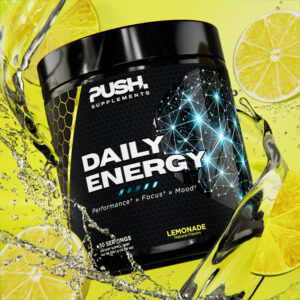
L-Citrulline at 4g for oxygen delivery during high output rounds, backed by research showing improved oxygen uptake kinetics and high intensity performance. (Journal of Applied Physiology) Taurine at 1g for endurance and cramp resistance. Raw honey powder at 1g for the dual sugar absorption described above. Himalayan salt and magnesium for the electrolytes the weight cut took from you. L-Tyrosine at 600mg and Alpha-GPC at 200mg for decision making when your brain is tired, with a study in resistance trained men showing meaningful cognitive improvement on the Stroop test after a single dose of Alpha-GPC. (NIH/PMC) L-Theanine at 100mg for the calm. KSM-66 Ashwagandha at 500mg for the cortisol load that started building the moment you woke up, with a placebo controlled trial showing a 27.9 percent reduction in serum cortisol over 60 days compared to 7.9 percent in placebo. (NIH/PMC)
No added caffeine, which is what makes it usable before every match instead of once in the morning. You can take it before your first match, take it again before a late one, and still sleep that night.
If you want the training day version of this, read supplements that do not cause jitters for jiu jitsu.